
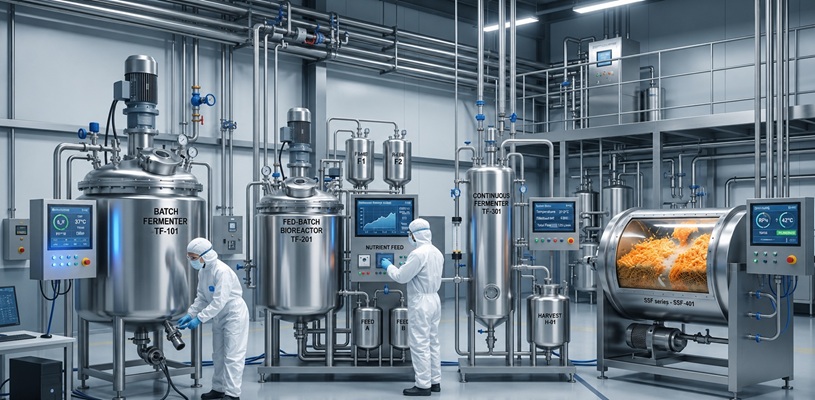
Choosing the right production layout for an industrial manufacturing plant is one of the most critical decisions a project engineer or biotech executive can make. It isn't just a matter of buying a large stainless steel tank; it is about matching the delicate biological needs of a living microorganism with heavy industrial machinery.
Selecting an incorrect cultivation setup directly impacts product purity, leads to unpredictable operational costs, and increases the risk of total batch failure.
This guide breaks down the four primary industrial fermentation configurations, evaluates their engineering trade-offs, and helps you determine the exact setup your manufacturing facility requires.
1. Batch Fermentation: The Closed System
Batch processing is the most straightforward cultivation method. Think of it as a closed ecosystem. All raw materials, nutrients, and the microbial culture are loaded into a sterile vessel at the very beginning of the cycle. The tank is then sealed, and the microbes are left to grow, mature, and produce the target substance.
Once the process reaches its peak, the entire tank is emptied for downstream purification, and the vessel is thoroughly cleaned and sterilized before the next run.
Key Advantages:
Best Suited For:
2. Fed-Batch Fermentation: The Controlled-Feed System
Fed-batch systems fix a major flaw of standard batch processing: nutrient depletion. In a simple batch setup, adding too many nutrients at the start can overwhelm and shock the microbes (a problem called substrate inhibition).
In a fed-batch setup, the cultivation begins in a partially filled vessel. As the cell population grows and consumes food, fresh, sterile nutrients are meticulously pumped into the bioreactor over time. This controlled feeding is guided by real-time data from online sensors tracking parameters like pH and dissolved oxygen.
Key Advantages:
Best Suited For:
3. Continuous Fermentation: The Open, Steady-State System
Continuous fermentation operates in a permanent state of balance. It is an open system where fresh, sterile growth medium is pumped into the top of the vessel at the exact same rate that fluid containing the finished product and spent cells is drained out from the bottom.
When calibrated correctly, the system reaches a "steady state." The cell population, nutrient levels, and waste products stay perfectly constant for weeks or even months at a time.
Key Advantages:
Best Suited For:
4. Solid-State Fermentation: The Low-Moisture Approach
While the first three methods rely on a liquid broth (submerged fermentation), Solid-State Fermentation (SSF) grows microorganisms on solid, moist surfaces. The growth happens on a solid bed—often agricultural byproducts like wheat bran, wood shavings, or rice hulls—with very little free-flowing water.
Key Advantages:
Best Suited For:
Engineering Decision Matrix: How to Choose Your Configuration
To choose the right vessel setup, plant managers and project engineers should weigh these key engineering factors:
|
Selection Factor |
Batch / Fed-Batch Systems |
Continuous Systems |
|
Contamination Risk |
Low to Moderate |
High |
|
Production Volume |
Low to Medium |
Extremely High |
|
Software & Compliance |
Medium Complexity |
High Complexity |
Key Technical Selection Criteria
1. Mechanical Stress and Sensitivity:
Some cell lines are extremely fragile. The aggressive stirring required to mix nutrients evenly in a massive continuous system can create "shear stress" that tears the cells apart. If your organism is sensitive to movement, a gentle, automated fed-batch or a highly specific loop design is mandatory.
2. Sterilization and Boundary Control:
Continuous systems run for hundreds of hours without stopping. This means your sterile boundaries must be absolutely flawless. A single microscopic leak in a valve can ruin weeks of continuous work. For high-consequence industries like pharma, choosing vessels built strictly to ASME BPE standards with zero-dead-lag designs is non-negotiable. Furthermore, your system must feature automated CIP (Clean-in-Place) and SIP (Sterilization-in-Place) lines to guarantee zero contamination between cycles.
3. Data Integrity and Global Regulations:
If you are manufacturing medical components, vaccines, or therapeutics, your data capture must be as reliable as your hardware. The automated control systems must monitor factors like pH, dissolved oxygen, and pressure in real-time while complying with global regulatory frameworks like 21 CFR Part 11. Every shift change, parameter tweak, and data log must be unalterable and securely recorded.
Summary Strategy & Next Steps
There is no single "perfect" fermentation system. The right choice requires a careful balance between your biological organism, your production scale, and your long-term operating budget.
Working with a turnkey engineering team early in your design phase prevents incredibly expensive field modifications later on. If you are ready to scale your bioprocess from a testing phase to a full production line, look for engineers who specialize in custom-built setups, zero-dead-lag vessels, and advanced automated controls.
|
Ready to Scale Your Bioprocess Safely? |
Frequently Asked Questions
What is the main difference between batch and continuous fermentation?
In batch fermentation, all ingredients are processed together in a closed system, and the tank is emptied completely at the end of the cycle. In continuous fermentation, fresh nutrients are constantly added, and finished product is continuously removed, allowing the machine to run indefinitely without stopping.
Why is fed-batch preferred over simple batch fermentation in pharma?
Fed-batch allows operators to add nutrients gradually based on how the microbes are growing. This prevents nutrient overload shocks, limits toxic waste buildup, and results in a significantly higher product concentration (yield) than a standard batch setup can achieve.
How do clean-in-place (CIP) systems reduce factory downtime?
CIP systems use automated spray balls, pre-programmed chemical washes, and hot steam loops to completely clean the inside of tanks and piping without tearing the machinery apart. This cuts down turnaround time between batches from days to just a few hours.